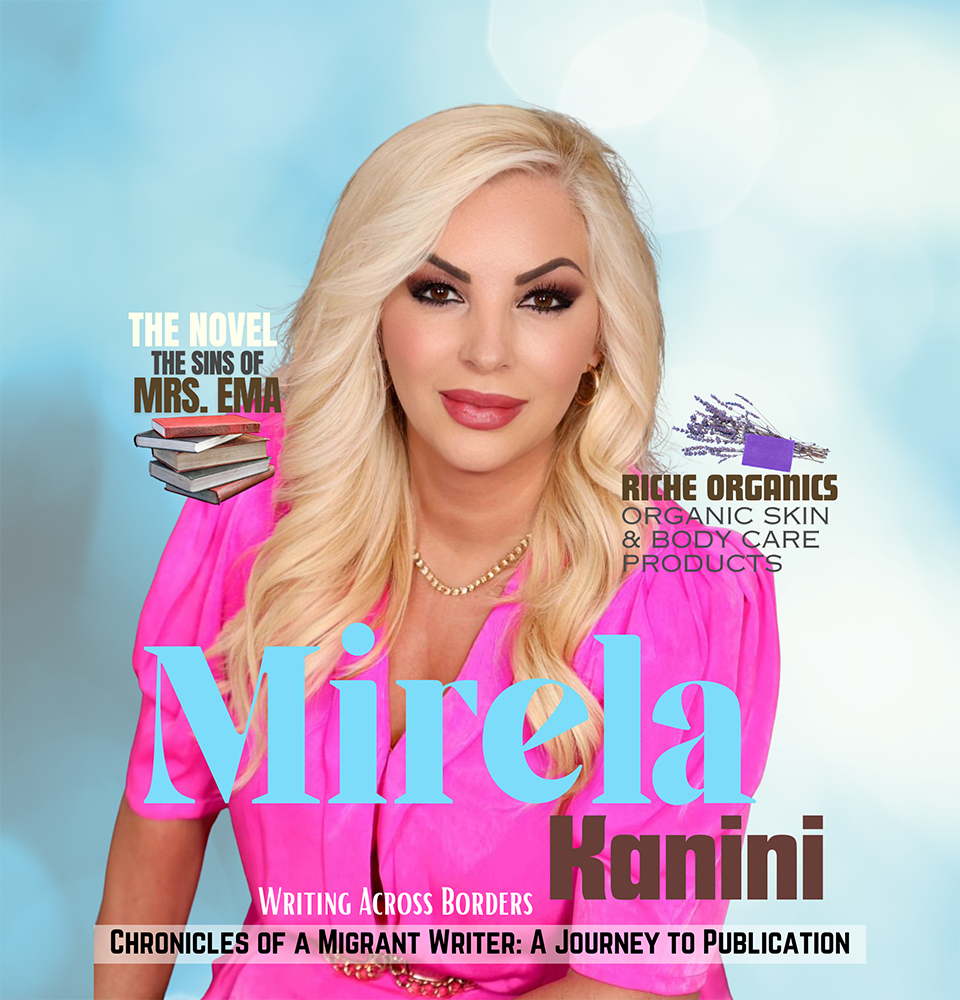
Some voices emerge slowly, discovered after years of reflection; others carry entire worlds of stories long before they even understand them. Mirela Kanini, the Albanian author who has built her life and career in the United States, belongs to the latter. For her, writing began almost the moment she could hold a pen, nurtured by silence, fear, and an unshakable drive to reveal truths that could not be spoken aloud.
Raised in Albania during the shadows of a communist regime, Kanini’s early life was shaped by restriction and observation. Every word written in secret, every story imagined, became an act of quiet rebellion. Her childhood scribbles were more than play—they were the seeds of empathy, courage, and moral inquiry that would later flourish in her novels. Writing was both a refuge and a declaration: a way to carve meaning in a world where expression was dangerous.

Her novels exist in the space between two worlds: the Albania of memory, tradition, and history, and the America of opportunity, reinvention, and freedom. In these pages, love contends with duty, desire wrestles with responsibility, and personal fulfillment often clashes with societal expectation. Kanini’s characters are not mere inventions; they are the embodiments of moral and emotional truth, shaped by circumstances beyond their control yet searching for agency within them.
In The Sins of Mrs. Ema, readers encounter a woman whose outward success masks a turbulent inner life. Wealth, stability, and social respect cannot shield her from the lingering shadows of a life shaped by dictatorship, suppression, and constrained freedom. The novel explores the intricacies of moral conflict—loyalty versus passion, duty versus desire—and reflects the emotional consequences of history itself. Through Mrs. Ema, Kanini captures the universal struggle of reconciling personal longing with the rigid structures imposed by society, making her story both intimate and emblematic of an entire generation.
Writing first in Albanian allows Kanini to remain intimately connected to the voices she represents—the voices of people who lived through restriction, migration, and resilience. Yet her work reaches beyond borders. Translations bring these stories to international readers, creating bridges of understanding and empathy. In novels such as The Trafficker, she explores love, survival, and the moral ambiguities of life in the diaspora, inviting readers to confront their assumptions and reflect on the forces—poverty, desperation, societal pressures—that shape human choices.
Her work is deeply philosophical, yet profoundly human. It probes questions of moral responsibility, the consequences of choice, and the enduring impact of history on individual lives. Themes of exile, memory, and identity recur, all illuminated with compassion and insight. Albanian traditions, such as besa—the sacred promise to protect a guest at any cost—anchor her stories, reminding readers that cultural memory is as vital as personal narrative.
Kanini’s life as an immigrant informs her vision. Living between two realities has honed her awareness of cultural nuance, moral complexity, and the interplay between past and present. Her novels offer not only entertainment but deep reflection: on human resilience, on the ways in which people navigate suffering, and on how compassion can guide us through the most challenging circumstances.
Mirela Kanini is more than an author; she is a cultural ambassador and a keeper of memory. Her writing is a mirror reflecting history, a lantern illuminating moral truth, and a bridge connecting the Albanian experience to the wider world. Through her stories, readers experience not only the lives of her characters but the very essence of humanity—its capacity for love, courage, and ethical reflection.
This May, 2026, in New York, when Mirela Kanini will be honored at the Albanian Stars Gala with the “Albanian Diaspora Excellence 2026” award, she will embody more than literary achievement. She will stand as a living testament to the power of storytelling, the resilience of the Albanian spirit, and the enduring impact of art that dares to speak the truth. In her words, we see history, morality, and compassion intertwined, and through her journey, we recognize the universal human quest for understanding, freedom, and meaning.